Of all the assets in a water and wastewater portfolio, few present a challenge as complex – or as critical – as the inverted siphon. Whether diving beneath a river, a railway line, or a major highway, these assets are engineering essentials. However, for asset managers, they represent a notorious “blind spot.”
By design, inverted siphons remain constantly full of water (drowned flow), operating under pressure rather than gravity. While this design is effective for transport, it creates a formidable barrier to inspection. As a result, many siphons fall into the category of “out of sight, out of mind,” deteriorating silently until a catastrophic failure forces them into the spotlight.
The difficulty of inspection is compounded by the “high consequence” nature of these assets. Siphons typically traverse sensitive environments. A structural failure beneath a waterway results in an immediate environmental disaster, leading to massive wastewater spills, severe regulatory fines, and public health risks.
The Anatomy of Deterioration
The unique geometry of a siphon – specifically the dip and the riser – creates an environment ripe for specific, hard-to-detect degradation mechanisms. Because standard inspection methods like CCTV are often rendered useless by the fluid-filled nature of the pipe (unless expensive bypass pumping is employed), the following issues often go unnoticed:
- Sediment and Blockages: Siphons rely on self-cleansing velocities to sweep solids up the riser. During low-flow periods, solids settle at the lowest point. Over time, this sediment hardens, reducing hydraulic capacity and creating friction that accelerates wear.
- Gas Pockets and Corrosion: Perhaps the most insidious threat is the accumulation of air and gas pockets at the high points or localised high spots within the siphon. In wastewater lines, trapped pockets often contain hydrogen sulfide (H2S). When this gas interacts with moisture on the pipe crown, it converts to sulfuric acid, rapidly corroding concrete and steel.
- Structural Uncertainty: Identifying changes in wall thickness or material degradation under a riverbed is virtually impossible with conventional tools.
High Consequence of Failure
The difficulty of inspection is compounded by the “high consequence” nature of these assets. Siphons typically traverse sensitive environments. A structural failure beneath a waterway results in an immediate environmental disaster, leading to massive wastewater spills, severe regulatory fines, and public health risks. Alternatively, a failure beneath a major highway can cause massive disruption and exorbitant excavation costs.
For decades, utilities have had to rely on guesswork or prohibitively expensive dewatering projects to assess these risks. The industry has long needed a non-destructive way to “see” through the fluid.
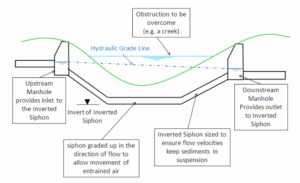
Diagrammatic Representation of an Inverted Siphon
The Solution: p-CAT Nexus
The paradigm is shifting with the adoption of advanced condition assessment technologies like p-CAT Nexus. This technology has emerged as a definitive solution for the specific challenges posed by inverted siphons, having already been successfully deployed across various utilities in Australia and New Zealand.
p-CAT Nexus utilises inverse transient analysis – essentially sending a controlled pressure wave (think less transient pressure than a kitchen tap) through the fluid column. Because the wave interacts differently with various physical anomalies, the system can decode the signal behaviour to build a precise sub-sectional profile of the pipe without draining it.
Why p-CAT Nexus changes the game:
- Detection of Gas and Air Pockets: It identifies exactly where gas is trapped. This allows operators to pinpoint areas where biogenic corrosion is likely occurring before the pipe crown collapses.
- Sediment and Blockage Mapping: The technology detects the restrictions in the internal diameter caused by sediment buildup, allowing for targeted cleaning rather than blind maintenance.
- Wall Thickness and Material Changes: Perhaps most importantly, it provides an average remaining wall thickness for sub-sections of the pipe. It can distinguish between material changes and detect diameter variations, providing a comprehensive structural health check.
- Operational Simplicity: The process is non-invasive and does not require taking the siphon out of service or bypass pumping.
Moving from Reactive to Proactive
The days of hoping a siphon holds up are over. With technologies like p-CAT Nexus, councils and utilities can move from a reactive stance to a proactive, data-driven maintenance strategy. By visualizing the internal condition of these drowned assets, we can extend their remaining useful life, prevent environmental catastrophes, and ensure the integrity of our most critical, yet hidden, infrastructure.
If you would like to learn more about our pipeline condition assessment solutions, please get in touch with us here.