Water utilities worldwide grapple with the significant challenge of non-revenue water, often stemming from physical leaks in aging infrastructure. Addressing this problem efficiently requires solutions that can accurately identify and locate leaks without disrupting service. INGU Pipers® technology offers a cutting-edge approach, utilising advanced sensor capabilities to provide precise leak detection, enabling targeted repairs and substantial water savings.
This case study explores the successful application of INGU Pipers® Glide by Triple A, a major water utility in Colombia, demonstrating its profound impact on reducing water loss.
Understanding the INGU Pipers® Solution
Pipers® is a free-swimming, un-tethered inspection tool designed to navigate through active pipelines. At their core, Pipers® is equipped with an acoustic leak detection sensor, which is crucial for their primary function. As a Pipers® travels with the water flow, it continuously records the ambient flow noise within the pipeline, establishing a baseline sound intensity. Leaks, even small ones, generate a distinctive hissing or rushing sound as water jets through cracks or holes. This characteristic sound significantly deviates from the established baseline, allowing the Pipers® to pinpoint the exact location of a leak.
Conversely, consistent sound intensity along a pipeline segment indicates the absence of leaks. While INGU Pipers® is versatile and equipped with various sensors for comprehensive pipeline diagnostics, this project specifically leveraged their acoustic leak detection capabilities.
Key Features and Benefits of INGU Pipers® include:
100% Uptime: Ensuring uninterrupted pipeline monitoring and data collection.
Rich Datasets Library: Providing extensive historical data for unparalleled analysis.
Non-revenue Water Detection: Identifying leak locations to minimise water loss.
Multi-Sensor Surveys: Offering comprehensive data on leaks, air pockets, pressure, buildup, and wall conditions in a single run.
Gas Line Inspection: Facilitated through a dedicated cleaning pig attachment and deployment.
Operational Versatility: Designed for use under live operational conditions, ensuring minimal disruption.
Utilisation of Historical Data: Leveraging past data for unprecedented analysis and insight.
Deployment and Retrieval
The deployment and retrieval of INGU Pipers® is designed to be minimally invasive, allowing inspections to occur without interrupting water service. Typically, INGU Pipers® is inserted into the pipeline through existing access points such as fire hydrants or specialised valve connections. Once inside, the natural flow of water propels the device through the pipe, allowing it to collect data along its path. Upon completing its inspection run, Pipers® is retrieved at a pre-determined downstream location, often another hydrant or valve, where it can be safely collected. The recorded data is then downloaded and analysed to generate detailed reports on leak locations.
Project Description: Triple A and Revicol Collaboration
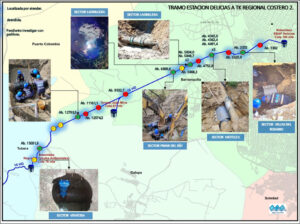
Triple A, a prominent water utility in Colombia, serves approximately 673,000 customers across a vast 3,800 km water supply network. The utility faced a substantial challenge with an average of 49.5% non-revenue water, a significant portion of which was attributed to physical leaks in its main pipes. Committed to drastically reducing this loss, Triple A partnered with Revicol to implement INGU Pipers® inspections. The initial inspection focused on a critical 16 km section of the coastal aqueduct’s main distribution system, a ductile iron pipeline with a diameter of 450mm, carrying potable water.
Remarkable Results
The INGU Pipers® inspection on the 16 km pipeline section yielded highly precise results, identifying 16 high-confidence leak locations. These leaks were categorised (e.g., green, yellow, red dots, indicating varying levels of severity or confidence). Following the inspection, Triple A initiated repair efforts, prioritising the “green marked” leaks. The impact was immediate and dramatic: the total water loss in the inspected section plummeted from 32.3 L/s to just 12.6 L/s.
This represents an astonishing 61% reduction in total water loss, translating to an annual saving of 621,260 cubic meters of water—an amount equivalent to the daily water use of 2,267,372 Australians. This project underscores the effectiveness of INGU Pipers® in providing actionable intelligence that leads to significant and rapid improvements in water network efficiency and sustainability.
If you would like to learn more about INGU Pipers® please get in touch with us today.